
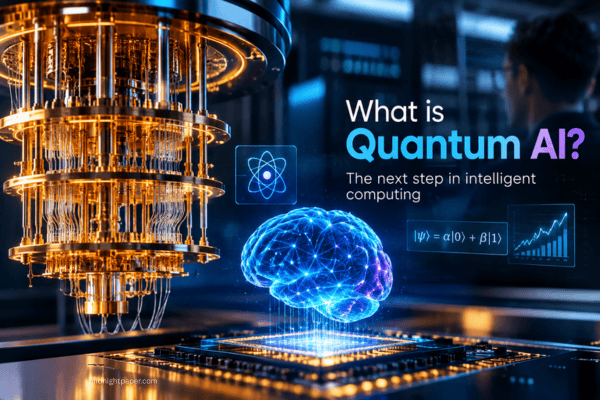
At this moment, in the age of AI, the biggest question on people’s minds is, “What is Quantum AI?”. Quantum AI is the mix of quantum computing and artificial intelligence. It means using new quantum computers to run AI models.
These quantum machines use qubits instead of regular bits. A qubit can be 0, 1 or both at the same time, thanks to a property called superposition. Qubits can also be entangled with each other, linking their states even when they are far apart.
This allows a quantum computer to explore many possibilities at once, which can help solve certain problems much faster than today’s computers. As one expert explains, “Quantum AI combines the powerful speed of quantum computing with the smart capabilities of AI”.
In practical terms, quantum AI aims to let AI models learn and run more quickly by tapping the raw power of quantum hardware. For example, AWS defines quantum AI as using quantum tech to run AI systems so models can “process data faster and cost-efficiently”.
Quantum vs Classical Computing
To understand quantum AI, first recall how normal computers work. Classical computers use bits that are either 0 or 1. They process data step by step. This works well, but big AI models need large computing power and time. By contrast, a quantum computer uses qubit units of information that can be in superposition of 0 and 1.
Physically, qubits are built from atoms or photons and follow the rules of quantum mechanics. Because of superposition and entanglement, a quantum processor can explore many possibilities at once. As a result, in theory it could solve some problems much faster than a classical computer.
For instance, SAS notes that quantum machines are used to solve complex problems that classical computers cannot. In practice, this means a quantum computer might try millions of solutions at the same time instead of one after another.
Right now, quantum computers are still young and small. Today’s devices only have a few dozen qubits, and they are prone to error. Their performance is limited by noise and short coherence times. Because of this, most current work mixes quantum and classical computing: a hybrid system where some tasks run on a quantum chip and others on a normal processor.
For example, a quantum AI workflow might prepare data or perform key calculations on a quantum unit (QPU) while using a CPU/GPU for the rest. Experts stress that for now quantum computers will not replace classical ones, but work alongside them as another tool. This hybrid approach is common until hardware improves.
How Quantum AI Works
Quantum AI covers many techniques and algorithms. In one view, Quantum Machine Learning (QML) is at its core. QML is the study of quantum algorithms for AI tasks like training a model or making predictions. In simple terms, quantum enhanced learning means encoding data into qubits and letting quantum circuits do some of the heavy lifting. These quantum routines aim to improve how quickly or accurately a model learns.
For example, a quantum optimization algorithm can search through many solutions at once, potentially finding a better answer faster for problems like scheduling or route planning. A quantum classifier uses a quantum circuit to label data. Researchers are also designing quantum neural networks (QNNs) that mimic classic deep networks but use qubits in their layers. These QNNs are still mostly theoretical today (tested on simulators), but they aim to see if quantum circuits can learn patterns in data. Another idea is quantum reinforcement learning, where an AI agent uses quantum states to explore many choices at once.
Quantum algorithms use superposition and entanglement to process large amounts of information simultaneously. Quantum AI utilizes these features for efficient data handling. The basic steps include encoding input data into qubits, applying quantum gates in a circuit, and measuring the results. These outcomes help update the model in the next step, repeating until the model learns.
Many current quantum AI projects are experimental. For instance, a quantum version of a recurrent neural network (RNN) has classified text. In one test, it matched the performance of a classical RNN using thousands of parameters on a sentiment analysis task with just four qubits. This suggests that quantum models could someday achieve more with fewer resources, but large-scale advantages for AI are still a future goal.
Benefits of Quantum AI
Combining quantum computing with AI could bring big benefits. Some of the most discussed advantages are:
Faster model training (lower costs):
Training a modern AI model is very compute- and energy-intensive. AWS notes that training large AI models often requires many GPUs or clusters, which is expensive and power-hungry. In theory, a quantum processor could run millions of operations in parallel on one device. This means large models might train in a single quantum machine instead of dozens of classical ones.
The result could be much lower training time and energy. For example, AWS explains that if an AI model could be trained with a single powerful quantum chip, we would not need huge distributed computing clusters. In turn, this could cut costs and carbon emissions of AI.
Better predictions and accuracy:
Quantum systems excel at certain types of complex calculations, like probabilistic simulations and optimization. Classical models sometimes simplify problems because of limits on computing power. Quantum AI could account for many more variables at once. This might lead to more nuanced predictions in fields like finance or weather forecasting.
For instance, AWS suggests quantum AI could improve financial risk assessment or portfolio optimization by analyzing market data in more detail. In general, by exploring a much larger solution space, quantum enhanced models might find patterns that classical AI misses, improving accuracy in tough tasks.
Accelerating scientific research:
Many sciences create large datasets and complex simulations. Quantum AI could help with this. For example, it can simulate atomic interactions in molecular chemistry and biology much faster than regular computers. This could improve drug discovery and materials research. Climate scientists could also use quantum models to simulate weather systems with vast amounts of data. Overall, fields like healthcare, materials science and climate studies could greatly benefit from quantum AI.
New types of AI algorithms:
Quantum AI isn’t just about making existing AI faster. It also opens doors to entirely new algorithms that aren’t possible on classical hardware. Current AI models (neural networks, decision trees, etc.) were built for classical computers. Quantum AI allows researchers to rethink model design from the ground up.
For example, there are early ideas for quantum neural networks and quantum-enhanced reinforcement learning that could learn in very different ways. These novel algorithms could tackle problems where today’s AI struggles such as long-term planning or learning with very incomplete data.
In practice, AWS describes quantum neural networks and quantum reinforcement methods as experimental
approaches that could one day extend what AI can do. Over the long term, this could lead to smarter AI that makes better decisions in complex environments.
Applications of Quantum AI
Researchers and companies are already exploring how quantum AI could help across industries.
Some key use cases include:
Healthcare and Pharma:

Quantum AI can significantly change medicine. It might speed up drug discovery by simulating how drug molecules connect with proteins.
Currently, this takes weeks or months with supercomputers, but quantum computers could do it in hours by exploring many molecular states at once. This could lead to quicker discoveries of new cures and treatments.
Companies like Google’s Quantum AI team are already working on these simulations. Quantum AI can also analyze medical data to find rare disease patterns in genetic information. SAS notes that simulating complex biological systems can greatly benefit healthcare and speed up drug discovery.
Finance and Trading:

The financial world deals with large data and complex models. Quantum AI can help optimize investment portfolios and assess risks by quickly exploring many options and analyzing market trends. SAS says that quantum AI could enable banks to create better trading strategies and enhance security by improving transaction protection methods.
In summary, quantum technology may improve investment management, detect fraud and secure communications.
Logistics and Supply Chains:

Scheduling routes, shipments, and inventories is a common challenge. Small improvements can save money and fuel. Quantum AI can find better solutions by evaluating many routing options at once. It may solve logistics problems over 100 times faster than traditional methods.
For example, Volkswagen used a quantum computer to optimize bus routes in Lisbon in real time. Companies like Maersk and DHL are testing these solutions with quantum startups. Quantum AI offers a new way to make supply chains faster and more efficient.
Manufacturing and Materials:

Factories and engineers should enhance production lines and discover new materials. Quantum AI can aid in both by effectively scheduling machines and managing robot tasks in smart factories. It can also rapidly simulate atomic structures of new materials, such as superconductors and lighter alloys, potentially advancing electronics and energy storage.
The common theme is solving combinatorial problems (many combinations to check) which are hard for regular computers but easier for quantum ones.
Energy and Climate:

Power grids and climate models are full of data and uncertainties. Quantum AI might optimize energy use by quickly solving grid-balancing problems, or improve weather/climate predictions by crunching large-scale simulations.
By analyzing more factors at once, quantum AI could improve forecasting and planning for renewable energy, resource management or disaster response. (These are active research topics rather than production use cases today, but many groups are studying them.)
Other areas of interest include cybersecurity (quantum secure encryption and anomaly detection) and AI itself. In fact, the field is broad: one survey notes that quantum AI can include not just machine learning, but also quantum search, reasoning and even fuzzy logic. In short, whenever a problem involves huge data or complex models in finance, healthcare, transportation or science, quantum AI has potential.
Challenges and Limitations
Quantum AI is promising, but it’s still very early days. Today’s quantum hardware is limited. Most quantum computers have only a few dozen qubits and are prone to errors (they are “noisy”). For many AI tasks, we would need hundreds or thousands of reliable qubits, which we don’t have yet.
As a result, current quantum AI work is mostly experimental. Often algorithms run on quantum simulators (classical computers simulating qubits) or very small quantum machines. As AWS explains, many concepts like quantum neural networks remain theoretical because current hardware can’t yet run them fully.
Key limitations include:
Hardware Noise and Scale:
Qubits lose their quantum state quickly (decoherence) and gates (quantum operations) are error prone. This means only shallow quantum circuits can run reliably now. We need better error correction and thousands of high-quality qubits for large-scale quantum AI. Until then, any speedup is hard to achieve. As one review notes, today’s machines have limited coherence and noise that limit reliability. We must wait for fault tolerant quantum computers (with error correction) to unlock full potential.
Hybrid Requirements:
Most quantum AI solutions today are hybrid due to hardware limits. This means tasks are divided between classical and quantum computers. For example, a quantum processor handles heavy calculations, while a classical computer manages data and logic. This method speeds up part of the workflow, but full end-to-end quantum AI is not yet possible.
Algorithmic Development:
We still lack mature, well-understood algorithms for quantum AI. Many proposed quantum learning methods exist only on paper or small-scale tests. It is an active research challenge to find which AI tasks truly gain from quantum techniques and how to implement them. Some experts warn of over hype: until a clear “quantum advantage” is proven for a real AI problem, claims should be cautious. Nevertheless, early results are encouraging.
Resource and Expertise:
Building quantum AI systems requires highly specialized knowledge in both AI and quantum physics. As one paper notes, QAI stands for the broad intersection of QC and AI, including many subfields. Companies and governments are investing in training people in this hybrid skill set. But it will take time to develop enough talent and tools. Meanwhile, access to quantum hardware is still limited.
Cost and Infrastructure:
Quantum computers are expensive and need special labs. At present, only large organizations or research labs can use them. Until costs come down and hardware is more accessible, quantum AI will remain mostly in labs and partnerships. In short, while the theory is exciting, real world quantum AI applications are still nascent.
The Future of Quantum AI
What’s next for quantum AI? Most experts believe this is a mid-term to long-term story. Large scale quantum AI probably won’t replace classical AI overnight. But research and technology are advancing quickly. Big tech companies (Google, IBM, Microsoft, Amazon) all have quantum research arms and governments around the world are funding quantum programs. In fact, some analysts predict the quantum computing market could explode: one SAS executive notes it might grow from tens of billions today to a trillion-dollar market by 2030.
Why so much optimism? Several trends are converging:
Better hardware: Year by year, quantum chips are gaining more qubits and better error rates. The goal of a 1000+ qubit, fault-tolerant machine is being pursued aggressively. When that arrives, it could indeed run large AI models or huge optimization problems. New algorithms: Researchers continue to invent and refine QML algorithms. Discoveries like complex-valued quantum word embeddings or quantum transformers show progress in applying quantum methods to real AI tasks. As more people study QML, more breakthroughs may come.
Hybrid approaches: In the near term, hybrid algorithms (mixing classical and quantum) will improve. Even if a quantum advantage is small at first, combining strengths can yield practical tools. Think of specialized AI chips (like Google’s TPUs); quantum processors might become another tool in the AI toolbox.
Rising demand: AI itself is growing rapidly (more data, larger models). Classical computing and cloud costs are rising. This creates demand for any technology that could ease the burden. Quantum AI is one candidate to fill that need. Even AWS acknowledges that current AI growth isn’t sustainable, so companies are looking at alternatives like quantum or neuromorphic chips.
Timelines for quantum computing are unclear, often described as “always five years away.” A recent review shows that while connections between AI and quantum computing are emerging, we will need future error free machines to see clear benefits, especially for large-scale AI tasks. We are close to a breakthrough early tests look promising, but scaling up remains challenging.
Amazon’s Braket and Microsoft’s Azure Quantum let developers try QML libraries today. Government labs like NASA’s Quantum AI Lab (in partnership with Google) are exploring space-and-AI problems together. Over the next decade, we may see pilot projects (e.g., quantum AI for traffic routing, supply chains or pilot healthcare diagnostics). Some applications may reach maturity faster than others fields requiring heavy optimisation or simulation (like logistics or chemistry) are prime candidates for early wins.
For now, we watch the research and prepare our data for a quantum future. As one analyst notes, melding AI and quantum computing is a strategic goal to secure leadership in healthcare, finance, materials discovery and security. With continued investment and breakthroughs, the fusion of quantum and AI could indeed redefine what computers and software can achieve in the 21st century.
Follow for more easy to understand topics on AI and tech.