
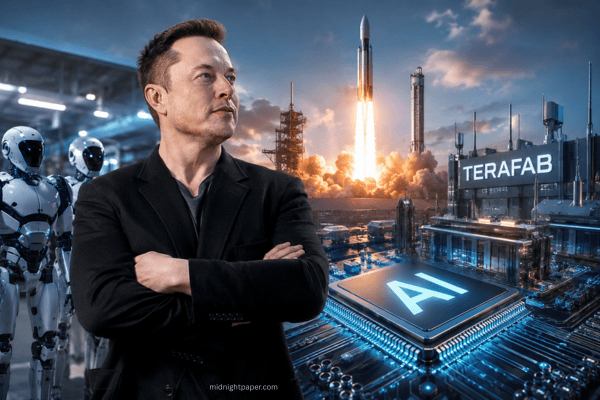
Terafab is a planned giant chip manufacturing complex announced by Elon Musk in March 2026. It is a joint project of Tesla, SpaceX and Intel designed to produce over one terawatt of compute capacity per year by combining all stages of chip production from design and fabrication to memory production and packaging in a single facility. In this article, learn what is TERAFAB and why Musk’s Tesla and SpaceX are building it. Find details on purpose, technology, timeline, partners and concerns.
The first phase (a research & prototype facility near Austin, Texas) will begin construction soon, followed by a full scale plant in Grimes County, Texas. The project involves massive investments (about $55 billion initially, up to $119 billion total) and has raised local concerns about environmental impact, land use and resource strains.
Purpose
To massively expand in-house chip capacity for AI and robotics by building the world’s largest semiconductor factory. It aims to close the gap between current chip production and the future compute demand of Tesla and SpaceX.
Technology
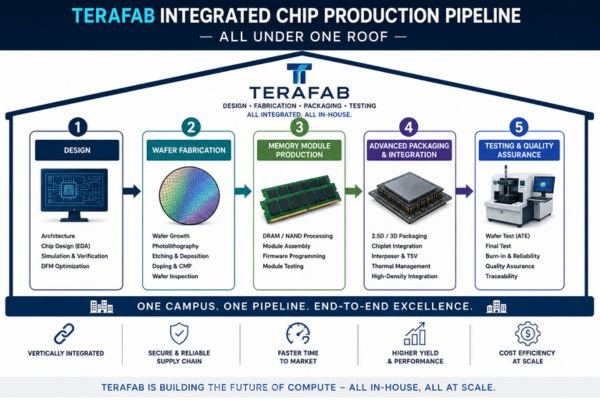
A vertically integrated fabrication plant: it will bring together advanced logic chip design, memory chip production and packaging or testing under one roof. The plant plans to use cutting edge processes for AI chips and memory.

Timeline
Announced Mar 2026, with prototype work already starting in 2026. First phase construction (R&D pilot plant) will begin later in 2026 and be completed around 2028. Full build out will happen in phases over several years, potentially up to the 2030s.
Partners
Tesla (chip design and prototype fab), SpaceX (lead on full scale construction and space-optimized chips) and Intel (manufacturing expertise and process technology).
Current Status
Plans filed and approvals in progress. Grimes County (TX) agreed to tax incentives in mid-2026. SpaceX and Tesla have announced a $16.8 billion first investment and the start of site work. Prototype “Advanced Technology Fab” at GigaTexas is under construction as a precursor.
Public Concerns
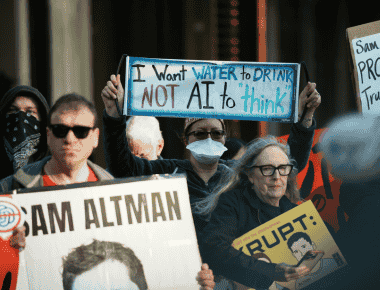
Some local residents and environmental advocates are worried about the project’s scale, water and power use, and impact on the rural community. The need for large subsidies and tax breaks has also faced criticism.
Purpose and Motivation
Terafab is intended to secure enough semiconductor chips for Musk’s companies. Musk has explained that the global chip industry cannot expand fast enough to meet his companies’ demands for AI and robotics hardware. He noted that existing fabs produce only about 2% of the chips Tesla and SpaceX will need. In his words, “We either build the Terafab, or we don’t have the chips, and we need the chips, so we build the Terafab”.

The facility’s goal is to produce integrated circuits, memory modules and multi chip modules at an unprecedented scale more than one trillion watts (1 terawatt) of compute capacity per year. This supply will power future products like self-driving systems, humanoid robots (Optimus), autonomous vehicles (Cybercabs) and space based AI data centres.
Terafab aims to keep chip manufacturing in the USA and reduce dependence on foreign factories. It will support Tesla and SpaceX by handling design and production in house, rather than outsourcing to companies like TSMC or Samsung. By locating the fab in Texas, Musk emphasizes the use of local resources and workers.
Technology and Operations
The key innovation of Terafab is vertical integration of the entire chip production process. Unlike typical semiconductor fabs (where design, wafer fabrication, memory chip production, packaging and testing happen in separate locations or companies), Terafab will perform all these steps under one roof. Tesla began constructing a prototype “Advanced Technology Fabrication” facility at its Texas Gigafactory site in 2026 for this purpose.
This pilot line is intended to handle everything from making photomasks to testing finished chips, enabling rapid iteration (“make a chip, test it, revise the mask, repeat”). The prototype aims to use very advanced process technology (targeting 2 nanometre class nodes) and an initial output of around 100,000 wafers per month, although Musk has noted early production might start smaller to “try out ideas”.
Intel’s involvement adds deep manufacturing expertise. In April 2026, Intel announced it would contribute its know how and 14A (1.4 nm) process to the project. Musk indicated Tesla will focus on the early R&D fab work while SpaceX leads the larger build-out. SpaceX has filed plans for using local water from Gibbons Creek Reservoir and advanced treatment to supply the factory, addressing some environmental concerns.
In marketing statements, Musk called Terafab “the most epic chip building effort” a factory combining
logic, memory and packaging in one location. According to SpaceX, the facility will house the full semiconductor production life cycle and enable very fast design cycles. It is expected to produce enough chips to serve vast AI hardware projects: Tesla’s Optimus robots and self-driving cars and SpaceX’s planned orbital AI satellites.
Timeline and Location
Musk first teased the idea in early 2026 and officially announced Terafab on 21 March 2026 at an event in Austin, Texas. The project immediately set an ambitious schedule. SpaceX filed a public plan in May 2026 for a $55 billion initial investment (with up to $119 billion if expanded) for the first phase. In June 2026 the local Grimes County authorities approved tax abatements and a reinvestment zone for the project, allowing construction to move forward.
The facility will be built in Grimes County, Texas (northwest of Houston) on land near the former Gibbons Creek power station. This site is about 70 miles from Tesla’s existing GigaTexas plant. In August 2026 Tesla and SpaceX confirmed that the full-scale Terafab campus (over 100 million sq ft) will indeed be in Grimes County. The initial phase (phase one) is slated to begin construction in late 2026 and create around 3,000 jobs. That first phase is expected to take a couple of years, roughly completing by 2028, and subsequent phases will follow as demand grows.
Key milestones for the timeline include: the March 2026 announcement, groundbreaking for the GigaTexas prototype fab in April 2026, tax vote approval in June 2026 and location confirmation in August 2026, with an initial investment of $16.8 billion. We recommend a simple timeline showing these steps from announcement through phase completions.
Partners and Investment
Terafab is a joint venture. Tesla brings chip design expertise (for its Full Self-Driving and AI hardware)
and is building the prototype fab near its vehicle factory. SpaceX is leading the project management and
will use many chips for its satellite and AI ambitions. Intel, one of the few companies with advanced semiconductor manufacturing, has agreed to join as a manufacturing partner. SpaceX’s filings estimate Tesla and SpaceX will each provide roughly half of the investment. In early 2026 SpaceX said it would put in $55 billion for phase one, potentially rising to $119 billion for all phases.
Officials say Grimes County plans to invest in infrastructure and offer incentives. The state of Texas awarded a $30 million incentive package to support the project. Overall, Terafab is expected to be one of the largest industrial projects ever undertaken.
Progress So Far
By mid 2026, Terafab has moved from concept to initial action. In April 2026, Tesla broke ground on the prototype Advanced Technology Fab at GigaTexas. In June 2026, Grimes County commissioners voted to approve tax breaks and a reinvestment zone for the project. In August 2026, Tesla and SpaceX announced they would invest $16.8 billion immediately to start building the Grimes County facility. About 3,000 workers will be hired in that first phase.
Elon Musk has highlighted the project on social media, calling it the “largest and most valuable building
on Earth by far” and saying it will be “50 times the size of the Pentagon” when complete. SpaceX’s website describes the plant as producing chips for both Earth and space use, emphasizing the revolutionary scale. Meanwhile, detailed design plans, environmental studies and construction permits are still in progress. The goal is to begin prototype chip production by 2026 and scale up to volume production by 2027-2028.
Public Response and Concerns
As with many large industrial projects, Terafab has faced public scrutiny. Residents in rural Grimes County have expressed worries about the factory’s massive scale and environmental impact. At public meetings some warned it could strain water and power supplies, harm wildlife, and change the county’s quiet character. Others complained about the speed of approvals and the use of tax incentives. Supporters, including local officials, argue the project brings jobs and will greatly boost tax revenues (Musk estimates it will raise county tax revenue by ~25%).
Industry analysts and media have noted that building a chip fab from scratch is extremely challenging and expensive. Some are skeptical Tesla and SpaceX, with limited chip making history, can pull off such a venture. Intel’s involvement is seen as vital to reduce risk. However, Musk remains convinced that without Terafab, his
companies would face crippling chip shortages.
Overall, while the project has been framed by its backers as a strategic move for U.S. technology leadership, it has also become a focal point for concerns about resource use (especially water and energy), local disruption and whether the promised benefits justify the incentives.
Conclusion:
Terafab represents an unprecedented effort to meet the looming chip needs of Tesla, SpaceX and future AI technologies. By consolidating every step of chip production into a single megafactory, the venture seeks to overcome global supply limitations. Announced in 2026, the project is still in early stages, with a prototype fab under construction and major investments planned. If fully realised, Terafab could produce trillions of custom AI and memory chips per year. However, its vast scale and cost mean it will unfold over many years, and its impact on the local community and environment remains a subject of public debate.
Frequently Asked Questions
What is the main goal of Terafab?
Terafab aims to build the world’s largest AI-focused chip factory under one roof. Its goal is to produce over 1 terawatt of computing power in chips each year, enough to support Tesla’s future autonomous vehicles and robots as well as SpaceX’s space-based AI infrastructure.
Who is involved in the Terafab project?
The project is a collaboration between Elon Musk’s Tesla and SpaceX, with Intel providing chip manufacturing expertise. Tesla handles chip design and pilot production, SpaceX manages construction and large-scale production and Intel offers process and factory knowledge.
Where and when will Terafab be built?
Terafab will be built in Grimes County, Texas (northwest of Houston) on land near the Gibbons Creek Reservoir. The project was announced in March 2026. Groundwork on
the first phase began by mid 2026, with construction starting in late 2026, and aiming for initial production by around 2027–2028.
How much will Terafab cost and who’s paying?
Initial investment for phase one is about $55 billion (split between SpaceX and Tesla), with total project costs possibly reaching $119 billion or more over several phases. Additional funding comes from state incentives and tax breaks approved for the project.
Why are some people concerned about Terafab?
Critics worry about its enormous size and environmental impact. In public hearings, residents cited potential strains on local water, power and wildlife, and changes to the rural landscape. There has also been debate over the use of tax incentives and how project benefits will be
shared. Supporters counter that it brings jobs and technology leadership, but the scale of Terafab has nonetheless drawn a degree of backlash.