
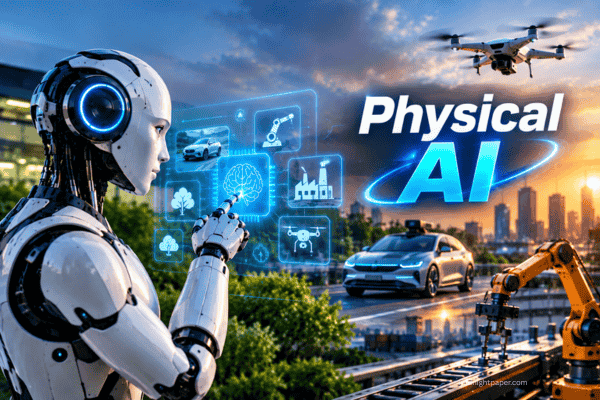
Physical AI refers to AI systems that perceive, reason about and act in the real (physical) world rather than just processing data in software. This means combining robots or devices with AI models, sensors, and actuators so they can move and make decisions about physical tasks.
In 2026, leading tech companies and research labs are highlighting “Physical AI” as a major trend. For example, Nvidia reports that modern “Physical AI” robots can sense, reason, and act with more autonomy, precision and adaptability than past generation machines.
Physical AI systems rely on a closed loop of perception, decision, and action. Sensors (cameras, lidar, microphones) feed data into AI models that build a model of the environment. The system then plans actions (motion paths, grasping movements, navigation commands) and executes them via actuators (motors, wheels, robot arms). After acting, the system gathers new feedback (did the robot grasp correctly? did the car avoid the obstacle?) and learns from the results. Over time, models are updated or retrained (often through techniques like reinforcement learning) so the machines can handle new or unforeseen situations.
What is Physical AI
Physical AI (also called physical artificial intelligence or embodied AI) means embedding AI intelligence into real-world machines. In simple terms, it’s about teaching a machine how to “think” and “act” outside of just a computer. According to definitions, physical AI systems “perceive, reason about and act within the physical world,” combining AI models with sensors, control systems and actuators like those on robots or vehicles.
This is different from digital AI (like chatbots or image generators), which only work on bits of data. Instead, Physical AI brings AI into the realm of atoms for example, a robotic arm that learns to pick up objects or a drone that learns to balance and fly in the wind.
In practice, physical AI overlaps with robotics and automation. It often uses the same machinery (robots, industrial arms, drones) but with smarter software. For example, an industrial robot arm that used to weld the same point repeatedly can be upgraded with AI so it can adjust on the fly if the pieces shift.
Equivalently, an autonomous car uses AI vision and planning to drive, unlike an old “cruise control” which only followed fixed instructions. As one source explains, physical AI takes AI “from the realm of bits to the realm of atoms,” letting advanced systems perceive their environment, apply knowledge (often from large AI models), act in the world and then learn from what happened. In summary, Physical AI means smart machines that do real work in the physical world.
History & Timeline of Physical AI
Year & Key Milestone or Trend
- 1954: First industrial robots and early automation concepts (Unimate robot in the 1960s).
- 1979: Early robotics milestones (Stanford Cart driving autonomously).
- 1997: AI breakthrough (Deep Blue beats Kasparov) illustrates AI progress (though not physical).
- 2000s: Rise of consumer robots (robotic vacuums) and drones; initial self-driving car experiments.
- 2010s: Deep learning and big data improve perception (computer vision, voice); growth of assistive robots.
- 2020: Generative AI (like ChatGPT) popularizes large models, inspiring new uses of AI in hardware.
- 2022: ChatGPT release brings AI into mainstream consciousness.
- 2023: Rapid advances in large AI models and robotics software.
- 2025: Researchers and companies begin using the term “Physical AI” for AI-driven robots and devices.
- Jan 2026: CES 2026 highlights robotics and self-driving cars as top physical AI exhibits. Tech leaders popularize “Physical AI” and predict a future with “a billion robots”.
This timeline shows how AI has gradually shifted from software-only tasks (like chess) toward real-world machines. In the early 2020s, breakthroughs in deep learning and generative AI (large language and vision models) raised expectations that AI could now tackle more complex, physical tasks. Recent demonstrations (CES 2026 and others) have cemented physical AI as a buzzword: virtually every robotics project now touts advanced AI perception and control.
Core Technologies Enabling Physical AI
Physical AI is built on a blend of hardware and software innovations. Key technologies include:
Sensors & Actuators: Physical AI relies on rich sensor inputs (cameras, LiDAR, radar, touch sensors, microphones) to sense the environment, and on actuators (motors, wheels, robotic arms, grippers) to move or manipulate. These components turn AI decisions into physical actions. For example, a self-driving car uses cameras and radar to detect obstacles; a factory robot uses cameras and force sensors to grip objects.
Machine Learning & AI Models: At the core are advanced AI models (neural networks, vision models, etc.) that interpret sensor data. Today, large language and vision models (LLMs/VLMs) also play a role by giving robots a kind of “common sense” about objects and language. These models are trained on vast datasets so the robot can recognize many objects or infer missing information.
In many systems, these learned models replace the old rule-based programming of robots. For instance, IBM notes that AI-powered robots paired with reinforcement learning can combine general knowledge (via LLMs) and task-specific training to handle varied tasks.
Reinforcement Learning & Real-World Learning: A major technique is reinforcement learning (RL), where robots learn by trial and error in simulations or controlled settings. An AI “agent” is rewarded for successful actions and penalized for failures, so over time it discovers strategies that work. This is how many tasks like a robot learning to walk or navigate are currently taught.
Nvidia explains that reinforcement learning teaches machines skills via millions of trials in a virtual environment, which prepares them for real-world operation. This act-observe-learn loop is essentially real-world learning in artificial agents.
Simulation & Digital Twins: Creating digital twins and simulated worlds is critical for training physical AI. High fidelity simulations let teams safely run countless scenarios from factory layouts to city traffic, without risking hardware or people.
For example, Nvidia emphasizes building physics-based simulations and digital twins so AI models can train on synthetic data. In these virtual environments, robots or vehicles operate under realistic physics, generating data that trains the AI before it ever encounters the real world. This greatly speeds up development and safety testing.
World Models: A new trend is giving robots an internal world model, a predictive model of how the environment will change with actions. Essentially, the AI learns to “imagine” future frames of sensor data or states. Advanced world models allow planning by simulating ahead (for example, “if I push the button, the conveyor will move”). According to a 2026 survey, world models have become central in robot learning because they let agents foresee action consequences and make better decisions.
Edge AI & Neuromorphic Computing: Many physical AI applications push processing to the edge (on-device) due to latency and connectivity needs. Edge AI chips enable real-time inference directly on robots or sensors. In parallel, neuromorphic computing is emerging for ultra-efficient physical AI: these chips mimic neural activity to run AI with very low power, which is valuable for small drones or IoT devices.
Control Systems & Motion Planning: Classical control and planning algorithms underpin these AI models. Once the AI decides on a goal, traditional robot motion planning techniques compute trajectories for arms or wheels. Modern systems often combine learned policies with these planners to achieve smooth, safe motions.
Embedded Vision-Language-Action (VLA) Models: Cutting-edge physical AI systems use multimodal AI that links vision, language, and action. For instance, recent Vision-Language-Action models allow a robot to “understand” instructions like “put the red block on the table” by processing images and text together. This was highlighted by IBM, noting that Robots with LLM-driven “common sense” can be paired with AI to execute versatile tasks.
Key Applications and Examples
Physical AI is finding real use across many fields:
Autonomous Vehicles: Self-driving cars and drones are classic physical AI platforms. They fuse camera and sensor data with AI to perceive lanes, obstacles, and traffic signs, then plan steering or flight paths. For example, companies like Waymo and Tesla deploy AI-driven cars on roads, using world models and simulation to handle unexpected situations. Drones in delivery or agriculture likewise use AI to avoid obstacles and optimize routes
in changing environments.
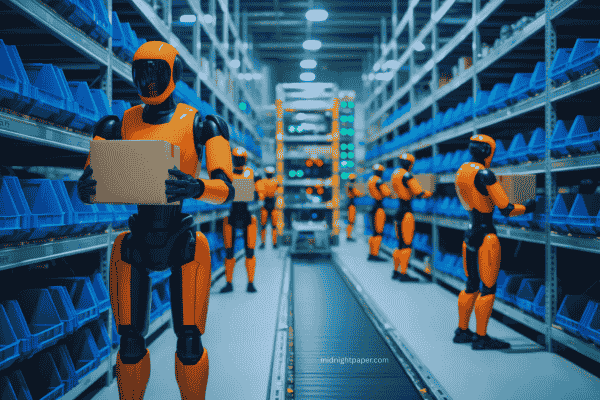
Industrial & Warehouse Automation: Modern factories and warehouses are major users of physical AI. Robots now learn to handle diverse tasks instead of just repetitive motions. For instance, FANUC (a robotics company) describes how “Physical AI helps manufacturers move beyond traditional robot programming by combining robotics, AI, real-time control, simulation and open platforms.” As a result, factory robots can adapt to moving parts on a conveyor or learn assembly by example.
In warehouses, Autonomous Mobile Robots (AMRs) navigate complex layouts and avoid humans or obstacles in real time using onboard AI and sensor feedback. Companies like Amazon use fleets of AI equipped robots to pick and sort packages with minimal human guidance.
Service and Personal Robots: Even consumer robots employ physical AI. Robotic vacuum cleaners and lawn mowers today use cameras or sensors to map homes and yards, planning efficient cleaning paths on the fly. For example, iRobot’s Roomba models can identify obstacles (like furniture) and learn the layout of rooms over time.
Surgical and healthcare robots also use Physical AI: advanced surgery robots now learn to manipulate tools with high precision by analyzing visual feedback. In homes, robots that assist the elderly or clean pools increasingly rely on AI perception and motion planning.
Smart Spaces and Infrastructure: Physical AI is used in buildings, factories, and cities to optimize operations. As Nvidia notes, AI-driven camera systems in factories can monitor people, vehicles and robots, improving safety and traffic flow. Likewise, smart factories use AI vision systems to detect anomalies on assembly lines or direct robots dynamically.
In construction and agriculture, autonomous tractors and harvesters scan fields with AI cameras to
operate efficiently. Even security and surveillance employ physical AI: robotic guards and automated camera-tracking systems can patrol areas and respond to events.
These examples show how physical AI goes beyond lab demos to practical use. Each case uses sensors and AI to handle real-world tasks like self-driving cars deal with weather and traffic, factory bots work alongside human workers and drones inspect power lines autonomously.
Benefits vs Limitations
| Benefits | Limitations |
|---|---|
| Greater autonomy & efficiency: AI-powered machines can work 24/7 and handle complex tasks with less human intervention. | Safety risks: Operating in the real world is unpredictable. Sensor errors or AI mistakes can lead to collisions or injuries. |
| Adaptability & precision: Robots can adjust to new objects or environments on the fly. | High cost & complexity: Advanced sensors, robots and computing hardware are expensive. Developing reliable physical AI systems requires major R&D investments. |
| New capabilities: Enable tasks dangerous or impossible for humans (hazardous cleanup, deep sea/space robots, assisted surgery). | Resource demands: Training and running AI models (often with reinforcement learning) require lots of data, compute power and energy. |
| Data-driven insights: Continuous sensing provides data for optimizing operations (smart traffic management, predictive maintenance in factories). | Privacy/ethical concerns: Sensors capture real-world data (video/audio) about people, raising privacy issues. AI decisions can be opaque, increasing the risk of bias or misuse. |
| Scalability: Once trained, AI policies can be deployed on many machines (e.g., multiple robots or vehicles) without reprogramming. | Simulation gap: Skills learned in simulation may not transfer perfectly to reality. Weather, wear and tear, or edge cases in the physical world remain hard to predict. |
The benefits column highlights why industries are excited about Physical AI: smarter automation, new use cases, and improved efficiency. But the limitations caution that real-world deployment is hard. Challenges like ensuring safety, handling incomplete or noisy sensor data, meeting real-time compute requirements and preventing harm are critical.
The cost of sensors and hardware also means widespread rollout may be slow. Finally, ethical issues (privacy of collected data, job displacement, accountability for decisions) must be managed carefully, since mistakes in the physical world can have serious consequences.
Ethical, Safety & Privacy Considerations
Physical AI raises important ethical and safety questions. Unlike purely digital AI, failures can cause physical harm or damage. For example, a mis-steered delivery robot or uncontrolled factory arm could hurt people or property, so safety constraints and human oversight are essential. Standards may require robots to have emergency stop features, fail-safe controls and exhaustive testing in varied conditions. Privacy is also a concern: devices with cameras or microphones collect environmental and personal data. Companies must ensure this data is handled securely and in compliance with privacy laws.
There are also societal issues. As physical AI systems become more capable, questions about job impact and ethics arise. Will autonomous machines replace certain workers, and how do we retrain the workforce? Who is responsible if a robot causes an accident the developer, operator, or owner? Minimizing bias is crucial too: an AI agent learning from real-world data might develop unsafe or unfair behaviors if not carefully supervised.
In short, ethical deployment of physical AI requires transparency, accountability, and often new regulations. Researchers and industry leaders emphasize that combining high-performance AI with strict safety measures is non -negotiable in this field.
FAQs
-
Q: What is Physical AI?
Physical AI refers to intelligent systems that operate in the real world by sensing their environment and acting on it. It’s essentially AI-equipped robots or devices that can see, reason and perform tasks in physical space.
-
Q: How is Physical AI different from traditional robotics?
Traditional robots often follow fixed programs or simple automation. Physical AI robots use advanced AI (like learning models) so they can adapt and learn from new situations, rather than just repeating pre-scripted tasks
-
Q: What technologies power Physical AI?
Key technologies include sensors (cameras, lidar), machine learning models (neural nets, vision/language AI), world models (predictive simulators) and control systems. Advances in edge AI hardware and reinforcement learning also help robots learn by trial and error in simulations.
-
Q: What are world models in Physical AI?
A world model is an AI component that predicts how the environment will change in response to actions. It lets a robot “imagine” future outcomes (for planning) and generate synthetic data. Modern physical AI often uses learned world models to plan and learn more efficiently.
-
Q: Can you give real-world examples of Physical AI?
Yes. Self-driving cars (using AI to navigate city streets), warehouse robots (automatically sorting and moving goods), robotic vacuum cleaners (mapping rooms to clean) and agricultural drones (surveying crops and acting) are all physical AI examples.
-
Q: Why is Physical AI important?
It enables automation of complex tasks in the physical world, improving efficiency and safety. For instance, physical AI can handle dangerous jobs (like disaster response robots) or mundane chores, augmenting human work. It’s a next step in AI’s evolution, moving from data-only applications into real-world impact.
-
Q: How do AI agents and large models fit into Physical AI?
Recent trends embed AI agents (often using large language or vision models) into robots. These agents use their broad knowledge (common sense, language) to better interpret tasks and environments. In practice, an AI agent can take a spoken or written instruction and help the robot carry out complex actions.
-
Q: What about safety and ethics in Physical AI?
Safety is critical. Physical AI systems must include measures like emergency stops and human oversight because their errors can cause harm. Ethically, concerns include protecting privacy (cameras recording people), ensuring transparency, and managing job shifts. The field stresses responsible design, testing and regulation.
-
Q: Is Physical AI just another name for robotics?
Physical AI is robotics enhanced by advanced AI, emphasizing how machines learn, perceive, and decide using AI models and computing approaches like edge AI and neuromorphic chips.
-
Q: What is the future outlook for Physical AI?
The field is rapidly growing. Experts predict more industries will adopt AI-driven machines. While general-purpose humanoids are still years away, incremental advances will continue expanding physical AI’s role in daily life and work.
Physical AI is opening a new frontier where software meets hardware. As this technology matures, we will likely see it reshape many aspects of our world, so keep learning and experimenting with the latest tools and research in robotics and AI.