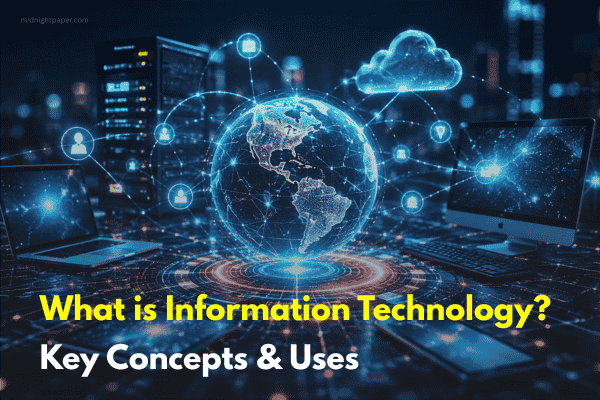
Information technology (IT) refers to the systems and processes that use computers, networks, software and data to create, process, store and share information. It underpins the modern digital world, enabling businesses and organizations in finance, healthcare, education and beyond to operate efficiently, communicate and make data driven decisions.
IT includes everything from desktop PCs and servers to mobile apps and cloud platforms. This article covers the definition and history of IT, its core domains (such as networking, software development, cloud computing and security) and practical examples of IT applications across industries.
Defining Information Technology
Information technology is broadly defined as the use of computer-based systems and digital tools to manage and exchange data. In practical terms, this means building networks and systems to store corporate data, running applications that power business operations, and using communication tools to collaborate. TechTarget explains that “information technology (IT) is the use of computers, storage, networking and other physical devices, infrastructure and processes to create, process, store, secure and exchange all forms of electronic data”.
In everyday terms, IT covers everything from personal computers and smartphones to enterprise servers, databases and internet infrastructure. One IT education guide notes that IT “encompasses the use of computers, software, networks, and other electronic devices to store, retrieve, transmit, and manipulate data,” calling it the foundation of digital infrastructure across industries. In business contexts, IT often refers to the integrated hardware, software and networking systems that allow organizations to function securely and efficiently.
Figure: Server racks and networking equipment in a data center, illustrating IT hardware and infrastructure.
Historically, the tools for managing information have been around for millennia (from the abacus to printing). However, the modern field of information technology really took shape after World War II with the invention of digital computers. The term “information technology” itself was first popularized in a 1958 Harvard Business Review article by Leavitt and Whisler. They used it to distinguish programmable computers from earlier machines.
In the decades that followed, rapid advances (such as the silicon microprocessor in 1971) led to personal computers, networking and the Internet. Today IT has evolved into a vast field; as new technologies emerge, IT systems continue to advance, becoming more powerful and efficient.
Key Domains and Technologies in IT
Information technology covers several core domains that work together to handle digital data. The hardware side includes physical components like desktops, laptops, servers, data centers and network devices. On the software side, it includes operating systems, business applications and custom programs that run on that hardware.
Networking is a critical piece: wired and wireless networks (such as Wi-Fi, Ethernet and telecom systems) connect devices so they can share information. For example, cloud computing, which delivers storage, processing power and applications over the Internet, is now a major part of IT.
Cloud services allow businesses to access scalable resources remotely, avoiding the need for local servers.
Data management and analytics is another domain, involving databases and tools that organize and analyze information for decision-making.
Security is a vital IT domain that overlaps all others. Often called cybersecurity, this area focuses on protecting systems and data from unauthorized access, hacking and other threats. Cybersecurity uses encryption, firewalls, antivirus software and best practices to keep networks and information safe.
Emerging fields like artificial intelligence (AI) and machine learning (ML) are also part of IT’s ecosystem. These technologies enable computers to perform tasks that normally require human intelligence such as recognizing images or processing natural language, by using advanced algorithms.
In short, IT ties together hardware, software, networking, data and security. Each piece is connected: for example, hardware like servers run software that relies on network connectivity, which must be secured by cybersecurity tools.
Figure: A flowchart of main information technology domains and their relationships (hardware, software, networks, cloud, data, security).
Figure: A developer’s workstation with code on-screen, representing software development and IT in practice.
Applications of IT Across Industries
IT is applied in virtually every industry and aspect of daily life.
In healthcare, for example, IT systems manage patient records (Electronic Health Records), connect doctors with patients through telemedicine, and analyze medical data to improve treatment.
In finance, banks use IT for online banking, digital transactions and algorithms that detect fraud.
Retail and e‑commerce rely on IT platforms for online shopping, inventory management and customer data analytics.
Manufacturing companies deploy IT in automation, robotics and supply-chain tracking (often called Industry 4.0). Governments use IT for services like digital IDs, tax processing and public safety networks. Even everyday conveniences like smartphones, streaming services or smart home devices all rest on IT infrastructure.
To illustrate scale, the U.S. software and IT services industry alone contributed roughly $489 billion in value to the economy in 2023, showing how vital IT has become. In a global sense, analysts expect the IT and tech services market to continue growing significantly in the coming years.
Overall, IT increases efficiency and connectivity everywhere: businesses run their operations on enterprise software, scientists process research data on powerful computers, and people around the world connect via the Internet. The reach of IT means that innovations from remote work tools to smart city systems constantly appear as the technology evolves.
Figure: A conceptual illustration of cloud computing with connected devices, highlighting IT’s cloud infrastructure and networking.
Conclusion
Information technology is the foundation of the digital age. It brings together computers, networks, software and data to enable modern business, research and everyday life. Since its mid-20th-century origins, IT has grown in power and scope from room-sized early computers to today’s global cloud platforms and intelligent systems.
Across industries, IT systems boost productivity and innovation: they allow companies to automate tasks, analyze information for smarter decisions, and protect sensitive data. IT continues to evolve; emerging trends like artificial intelligence, Internet of Things (IoT) and advanced cybersecurity solutions are expanding what IT can do.
For anyone in a connected world, understanding the basics of IT helps make sense of how devices and digital services work together. In summary, information technology is everywhere it is the backbone of modern communication and commerce, and its development will shape the future of work and society.