
Python continues to shine as a versatile, high‑demand language, and 2026 is a great time to dive in. This guide breaks down why Python remains essential (from AI to web to DevOps) and lays out a step‑by‑step learning plan. It covers core skills by timeline, key libraries across domains, tools, and best practices, career paths with sample projects, and tips to stay current.
You’ll find an executive summary of trends, a clear timeline (with a simple Mermaid chart), a study plan table, and a bullet list of project ideas. This roadmap is geared to help both beginners and intermediate programmers build strong Python skills for the evolving job market.
Why Learn Python in 2026?
Python’s popularity keeps growing. In the 2025 StackOverflow survey, 57.9% of developers reported using Python (up 7 points in one year), reflecting its fast adoption. Indices like Tiobe and PYPL also rank Python at or near the top. With over 16 million developers worldwide, Python has a massive community and ecosystem of libraries.
The demand for Python skills is strong across industries. Major sectors rely on Python for their tech stacks: AI/ML and data science (TensorFlow, PyTorch, pandas), web development (Django, Flask, FastAPI), automation (scripts, RPA), cloud/DevOps (automation scripts, AWS/GCP SDKs), finance, healthcare, IoT, education, and more. For example, finance and healthcare companies use Python for analysis and web services, while research labs use it for AI. The U.S. Bureau of Labor Statistics projects 25% growth in software developer jobs (a category that includes Python) by 2031.
Trends driving this demand include the AI/ML boom, growth in cloud and DevOps, and ongoing needs for automation. Python’s role in AI exploded with libraries like scikit-learn, TensorFlow, and Hugging Face (for NLP). In cloud/DevOps, Python scripts glue together AWS/GCP services and CI/CD pipelines. Its ease of learning and rich libraries means businesses use Python everywhere for faster development and automation.
Python jobs often offer good pay and flexibility. In India, entry salaries for Python devs range broadly, with senior roles in AI or cloud hitting ₹15–30L+ per year. Remote and freelance Python jobs have grown too, making for “borderless” opportunities. All this means learning Python opens doors in tech.
Core Python Skills and Timeline
Getting comfortable with Python is a gradual process. Here’s a suggested skill timeline with milestones, roughly grouped by learning stage:
0–3 Months (Beginner):
Set up Python and learn syntax. Focus on variables, data types (strings, lists, dicts), control flow (if, loops), and basic functions. Practice writing small scripts (e.g. text processing). Start using the official tutorial and docs for reference. Week by week:
- Week 1: Install Python (latest 3.x), set up a development environment (VS Code or PyCharm). Learn simple syntax (printing, variables, arithmetic).
- Week 2: Study basic data structures (strings, lists, dictionaries, tuples) and indexing/slicing.
- Week 3: Learn control flow (
if/else,forandwhileloops). Do practice problems (e.g. exercises on lists). - Week 4: Write and use functions; understand scope and parameters. Start reading Python docs for functions.
3–6 Months (Intermediate):
Dive deeper into Python core. Master data structures, file I/O, error handling, modules, and object‑oriented programming (classes, methods, inheritance). Begin using Python’s built‑in libraries (for file handling, dates, etc.) and try simple libraries like requests or BeautifulSoup. Week by week:
- Week 5-6: Advanced data structures and built‑in functions (e.g.
map,filter). Practice list/dict comprehensions. - Week 7-8: File input/output (reading/writing files, JSON, CSV). Learn
try/exceptfor error handling. - Week 9-10: OOP basics: define classes, understand
self, make simple objects. - Week 11-12: Work with modules and packages. Use
pipto install a library. Experiment with a simple library (likerequeststo fetch a webpage).
6–12 Months (Advanced Topics and Projects):
Focus on specialized skills and larger projects. Learn about testing (pytest), debugging, and logging. Explore concurrency (asyncio, threading). Pick a domain: web (Flask/Django), data (pandas), or ML (scikit-learn/TensorFlow). Build small projects in that area. Week by week:
- Week 13-16: Start a web mini‑project or data analysis. Learn a web framework (Flask or Django) for a basic app, or learn NumPy/pandas for data manipulation.
- Week 17-20: Explore testing with
pytest, version control with Git/GitHub. Practice by writing tests for your code. Learn to usevenvorcondafor virtual environments. - Week 21-24: Work on a capstone project (see sample projects below). If you chose web, add a database. If data, build a visualization or a simple ML model.
12+ Months (Specialization):
Continue building real projects and explore advanced topics. Learn async programming, performance tools (profilers, JIT). Study more libraries in your niche (e.g. TensorFlow/Keras for ML, Streamlit for dashboards, etc.). Read PEPs (Python Enhancement Proposals) to follow new language features. Keep practicing coding challenges and contributing to open source.
Below is a simple timeline illustrating this roadmap:
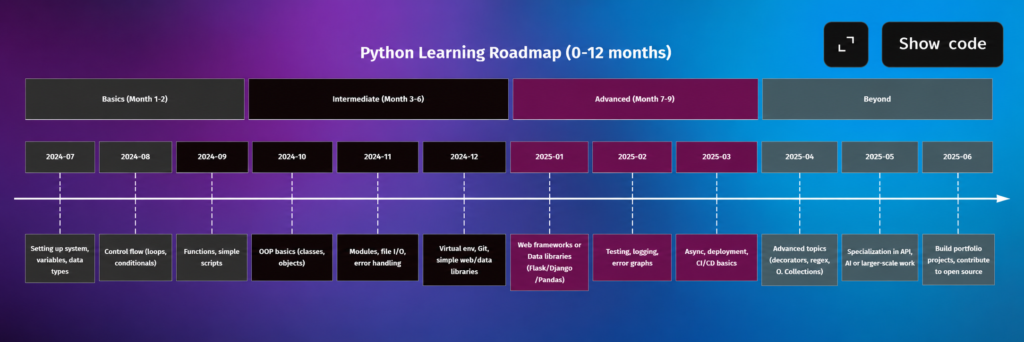
This timeline is just a guide. You can adjust the focus and pace to fit your goals. The key is to set weekly goals (as shown above) and consistently practice and build projects.
Key Libraries and Frameworks by Domain
Python’s ecosystem is huge. Here are some major libraries and frameworks in 2026 worth learning, organized by domain:
Web Development:
Django: A mature “batteries-included” framework for full-stack apps. It provides an ORM, admin interface, authentication, and more out of the box. Ideal for large, data-driven sites.
Flask: A lightweight micro-framework that is quick to learn and great for smaller projects or microservices. It gives more flexibility since you choose the components.
FastAPI: Built for modern async Python, it shines for building high-performance APIs with auto-generated docs. It uses Python type hints to boost performance and ease development, making it popular for production APIs.
Reflex (and similar): Newer tools like Reflex (formerly Pynecone) let you build full-stack apps purely in Python by generating React frontends. These are growing options for AI/data apps.
Streamlit/Dash/Gradio: Great for data apps. Streamlit and Dash simplify creating interactive data dashboards without much web code. Gradio is excellent for quickly exposing ML models as web interfaces. All help data scientists showcase results fast.
Data Science & Visualization:
NumPy: The core library for numerical computing (arrays, math functions). It’s fundamental for most data work.
Pandas: Essential for data manipulation and analysis. It provides DataFrame structures to load, clean, and analyze data (like SQL tables in Python). Many analysts say “pandas is a go‑to tool for data work.”
Matplotlib/Seaborn/Plotly: For data visualization. Matplotlib is the base plotting library; Seaborn builds on it for statistical plots; Plotly (and Dash) for interactive charts.
SciPy: Builds on NumPy for scientific computing (optimization, stats). It’s often used in engineering and research.
Machine Learning & AI:
scikit-learn: A user-friendly library for classical machine learning (regression, clustering, etc.). Good for getting started with ML.
TensorFlow/Keras: A major deep learning framework, widely used in industry (Google) and production.
PyTorch: The other dominant deep learning framework (by Meta), very popular in research. It’s Pythonic (eager execution) and often leads the cutting edge.
Hugging Face Transformers: The standard library for state-of-the-art NLP and large language models. If you’re into LLMs or NLP, this is a must.
XGBoost, LightGBM: Popular gradient boosting libraries for tabular data. Common in data science competitions and enterprise ML.
Automation & Testing:
Requests: The go‑to HTTP library for web requests (replacing urllib’s complexity). Nearly every web script or scraper uses it.
Beautiful Soup / Selenium: For web scraping and browser automation. Use Beautiful Soup for simple HTML parsing, Selenium for interacting with dynamic web pages.
PyAutoGUI / python-telegram-bot: Examples of libraries for GUI automation or building bots that are useful for small automation or bots.
pytest: The leading testing framework (easy syntax, powerful fixtures). It makes writing tests straightforward and scales to large projects. (It is considered best practice to write tests as you learn.)
Career Paths and Sample Projects

Python skills open many doors. Here are some common career roles and what they typically require:
Software Engineer (Backend or Full-Stack): Builds applications and services. Skills: strong Python fundamentals, REST APIs (Flask/FastAPI/Django REST), databases (SQL/NoSQL), version control, understanding of servers/cloud. Projects: building a web app or microservice.
Web Developer: Focus on websites. Skills: Python (Django/Flask), HTML/CSS/JavaScript basics, frontend frameworks (React/Angular optional), SQL, deployment (AWS/GCP/Azure). Projects: a dynamic website (blog or e-commerce demo).
Data Scientist / Analyst: Analyzes data and builds models. Skills: Python, pandas/NumPy, data visualization (Matplotlib/Seaborn/Plotly), statistics, scikit-learn or TensorFlow, Jupyter. Projects: data analysis report (e.g. sales data analysis), predictive model on a Kaggle dataset.
Machine Learning Engineer: Production-level ML. Skills: Python, TensorFlow/PyTorch, model training/deployment, big data tools (Spark, Hadoop optional), cloud ML services, version control. Projects: end-to-end ML pipeline (from data cleaning to model serving).
DevOps / SRE: Automates infrastructure. Skills: Python scripting for automating tasks, Docker/Kubernetes, CI/CD pipelines, cloud platforms, monitoring tools. Projects: Infrastructure automation (e.g. script to deploy app on AWS) or containerizing an app.
QA / Test Automation: Writes automated tests for software. Skills: Python, pytest or Selenium for test scripts, knowledge of the software development lifecycle, Git. Projects: Build a test suite for a sample web app or API.
Data Engineer: Manages data pipelines. Skills: Python, SQL, Apache Airflow, ETL tools, big data (Spark), cloud data services. Projects: a simple ETL pipeline moving data from one source to another with transformations.
Scripting/Automation Specialist: Writes custom scripts to automate tasks (e.g. file processing, report generation). Skills: Python, familiarity with OS tools, possibly web APIs. Projects: an automation tool (like a CLI script to batch-rename files or scrape websites and email results).
Building a strong portfolio of projects is vital. Below are 8 sample project ideas you could build to showcase your skills:
- A portfolio website built with Django or Flask, featuring your resume and blog.
- A data analysis dashboard (using Streamlit or Dash) that visualizes a public dataset (e.g. Covid trends or stock prices).
- A machine learning model project: train and deploy a model (e.g. an image classifier or sentiment analyzer) with Flask or FastAPI.
- A REST API built with FastAPI that serves data (e.g. a books API or weather service).
- A web scraper that gathers information (like news headlines or product prices) and stores it for analysis.
- An automation script or CLI tool, such as a to‑do list manager or a file organizer (using
argparseor Click). - A chatbot or NLP app using HuggingFace Transformers (e.g. a simple chatbot or text summarizer web app).
- A game or GUI application (e.g. a small game with Pygame or a desktop app with Tkinter).
Each project should highlight different skills (web dev, data, ML, automation, etc.) and be well-documented on GitHub. Employers love seeing real code and problem-solving in portfolios.
Learning Resources
To learn effectively, use diverse resources:
Official Documentation and Guides:
Python’s official docs (docs.python.org) cover everything from beginner tutorials to advanced topics. Each library or framework also has its official docs (e.g. Django docs, Flask docs). Reading these is crucial. Refer to PEPs on the Python website to understand new language features and style guidelines.
Interactive Courses and Tutorials:
Online platforms (edX, Coursera, Udemy, Codecademy, etc.) offer structured Python courses. Many are taught by universities or reputable instructors. Interactive tutorials (like Real Python or freeCodeCamp) and platforms with coding exercises help reinforce learning.
Books:
There are excellent Python books. For beginners: “Automate the Boring Stuff with Python” by Al Sweigart or “Python Crash Course” by Eric Matthes. For deepening knowledge: “Fluent Python” by Luciano Ramalho covers advanced idioms, and “Effective Python” by Brett Slatkin has practical tips. “Think Python” (Allen Downey) is another gentle intro. For data science: “Python for Data Analysis” by Wes McKinney (creator of pandas).
Community and Videos:
Watch tutorial series on YouTube (e.g. freeCodeCamp, Tech with Tim). Join forums like StackOverflow or communities like Reddit’s r/learnpython. Participate in local or online Python meetups and hackathons. Reading blog posts (e.g. RealPython, Towards Data Science) keeps you updated on practices and trends.
Practice Platforms:
Use coding challenge sites (LeetCode, HackerRank) to improve problem-solving with Python. Participate in open-source projects on GitHub to learn collaboration and best practices.
Conclusion and Call-to-Action
Learning Python in 2026 is a solid choice. Its role in booming fields like AI, data science, web and cloud development ensures Python skills stay in demand. By following a structured roadmap—covering fundamentals, key libraries, real projects, and best practices—you can build a strong skill set.
Next steps: Start coding today. Pick one weekly goal above and tackle it step by step. Use the official docs and try a mini project. Share your journey, seek feedback, and keep iterating. With consistency and practice, you’ll join the millions of Python developers shaping the future.
Stay tuned for more easy to follow content that makes Tech Knowledge very simple to learn and apply. Our goal is to break down complex ideas into clear, engaging insights you can actually use.