

Generative AI can create text, code, images, and more, and it is quickly changing the field of cybersecurity. By learning from large amounts of data, these AI models can simulate attacks, analyse complex logs, and help draft defence policies. Experts say that generative AI is changing cybersecurity by providing better threat detection, automation, and data analysis.
The market for AI-driven security tools is growing rapidly; one study predicts that the generative AI cybersecurity market will rise from about $8.65 billion in 2025 to $35.5 billion by 2031, with an annual growth rate of around 26.5%. Companies of all sizes, from Fortune 500 firms to critical infrastructure providers, are investing in AI-enhanced security as cyberattacks become more serious.
However, this technology can be both a help and a risk: it can aid both defenders and attackers. This article looks at how generative AI can improve cybersecurity, focusing on its key uses, benefits, and the challenges of using AI as a defence tool.
What Is Generative AI and Why It Matters for Security
Generative AI is a type of machine learning that creates new content. It uses large language models (LLMs) to respond to prompts or data, producing realistic output. For example, it can write a phishing email, create an image of an attack map, or summarise a security report. These models learn from lots of data and generate new data that resembles those patterns.
In cybersecurity, generative AI can create fake network traffic, realistic attack scenarios, or even generate code. For instance, it can produce synthetic datasets to train detection algorithms without risking real sensitive data. By simulating cyber threats, generative AI helps security teams predict attacks before they happen.
AI tools like ChatGPT and other specialised models can quickly analyse log files, suggest responses, or write code. This gives security teams a valuable assistant. An expert notes that generative AI can be a powerful tool for both defenders and attackers in the field of cybersecurity.
Learn More: Artificial Intelligence – a beginner-friendly guide
Major Applications of Generative AI in Cybersecurity
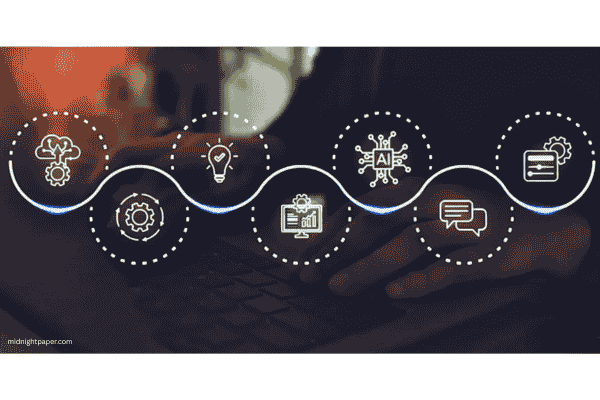
Generative AI’s versatility means it can be applied to a wide range of security tasks. Key uses include:
Advanced Threat Detection and Anomaly Analysis:
AI models can help detect threats and analyse unusual activities in networks or user behaviour. They establish what normal activity looks like and alert us to anything that strays from this norm. By understanding patterns of regular actions, these models can identify subtle signs of security breaches or insider threats. Generative AI can also create simulations of malware and attack traffic. This helps analysts understand new threats before they become widespread. For example, an AI could generate a sample of suspected ransomware activity and check if current defences would detect it. This “what-if” approach gives teams a head start against unknown attacks.
Automated Incident Response and Remediation:
When there is a security breach, generative AI can help manage the response automatically. It can suggest or create guides and scripts to isolate affected systems, apply security updates, or stop malware. For example, if a vulnerability is found, an AI tool can scan the code, spot the issue, and create a fix or a plan to resolve it. Generative AI can also automatically write incident reports and summaries, allowing analysts to focus on more important tasks. This speeds up the process of handling alerts; one cybersecurity leader noted that AI tools “helped reduce alert investigation times by 48%” in real situations.
In summary, automating routine security tasks, like reconfiguring firewalls, updating software, isolating threats, and writing reports, reduces the workload for human analysts and speeds up crisis management.
Phishing Detection and Prevention:
Phishing is a serious threat, and generative AI can help detect and fight against it. AI models analyse email language and website content for signs of phishing, learning from real-world examples to identify details that regular filters might overlook. This allows organisations to automatically flag phishing attempts.
Moreover, generative AI can create realistic phishing simulations for training, crafting emails that fit the specific context of the organisation. These simulations improve security awareness training and help employees prepare for advanced social-engineering tactics.
Data Privacy and Synthetic Data Generation:
Handling sensitive data can be difficult for security analysis. Generative AI helps by creating fake data that looks like real datasets without showing personal information. For instance, AI can generate a fake database of customer records that has similar patterns to real data. Security models or compliance checks can be trained and tested on this fake data, reducing the risk of a data leak. This method, called data masking or privacy preservation, lets teams train their protection models effectively without using actual confidential data. It also helps organisations follow privacy rules while still using AI for analysis.
Vulnerability Management and Code Security:
Generative AI can greatly improve how we scan and fix code. It understands natural language and can check software for security weaknesses, suggest fixes, or even create code patches if needed. For example, if the AI finds a buffer overflow issue, it can provide a code snippet or recommend changes to fix it. This method, called ‘AI-assisted patching,’ speeds up how we manage vulnerabilities.
Tools like Microsoft Security Copilot help security analysts communicate with systems using simple language. They can summarise vulnerability reports and get specific suggestions for fixes. This AI support not only makes the security process smoother but also helps less experienced engineers better secure their code and network settings.
Security Policy and Compliance Automation:
Creating security policies can be a boring task. Generative AI can help by customising security and compliance documents to fit an organisation’s needs. For example, an AI system can draft a risk assessment or a GDPR compliance report using the company’s specific information. It can also automatically generate answers to security questions or complete standard audit forms based on previous assessments. This approach helps companies keep their security policies and evidence current with less manual work.
Training and Simulation:
Realistic exercises are important for preparing for threats. Generative adversarial networks (GANs) and other AI tools can create training simulations based on different scenarios. They can mimic various cyberattacks, such as malware attacks, DDoS attacks, and social engineering tricks, in a controlled lab setting. This allows security teams to experience new types of attacks that they might not face otherwise. These AI-driven practice sessions help analysts learn about attacker methods and improve their responses before real threats happen.
Reporting and Intelligence Summarisation:
Generative AI is great at turning raw data into stories. It can take security logs and findings and turn them into clear, actionable reports. For example, after a breach, an AI assistant can create a timeline of events, point out key anomalies, and suggest next steps in simple language. This helps non-technical leaders understand technical findings. AI-generated reports can change based on the audience, providing detailed analysis for engineers and summarised recommendations for executives.
These applications often blend. For instance, an AI-driven intrusion detection system might continuously learn network patterns (detection), flag anomalies (alerting), and then suggest mitigation steps (response automation). The common theme is that generative AI augments cybersecurity teams by handling complexity and scale that would overwhelm humans.
Examples of AI-Powered Security Tools
Generative AI is now part of major security products. For example, Microsoft Security Copilot works with Defender and Sentinel, allowing analysts to use simple language to conduct threat hunts, summarise incidents, or prioritise alerts. IBM’s Cybersecurity Assistant provides real-time insights on threats and cuts alert investigation time by about half.
Google’s Gemini AI enhances new threat intelligence services and enables easy searches across large security databases. These tools use generative models to turn raw security data into clear advice, making complex tasks feel as easy as chatting. Even specialised firms offer GenAI.
For instance, CrowdStrike’s “Charlotte AI” acts as a chatbot security analyst. Users can ask it questions about their network in everyday language, and it gives tailored answers based on the Falcon platform. In short, organisations of all sizes are using AI assistants to boost their cyber defences.
Benefits of Generative AI for Cyber Defence

The advantages of using generative AI in security are significant:
- Speed and Efficiency: AI can quickly analyse and connect large amounts of logs and alerts. It works faster than humans and takes care of repetitive tasks, like sorting alerts, checking logs, or setting up firewalls. This allows analysts to focus on important threats. Many teams report saving a lot of time; one study found that using AI tools can cut investigation time by up to 48%.
- Improved Accuracy and Proactivity: By continuously learning from data, generative AI tends to catch subtle patterns that static rules might miss. It helps shift cybersecurity from a reactive mode to a proactive one. For example, an AI model trained on historical breaches can predict likely next steps an attacker might take and alert defenders in advance. The system effectively simulates future attacks based on learned intelligence.
- 24/7 Operation and Consistency: AI systems can work all the time without getting tired. They can watch networks and enforce rules continuously, so there are no gaps due to shift changes or human mistakes. They also give consistent results, while human analysts may have different opinions.
- Scalability: AI systems don’t sleep or get fatigued. They can monitor networks and enforce policies round-the-clock, ensuring no shift changes or human errors create blind spots. They also provide consistent results, whereas human analysts can have varying judgments.
- Enhanced Insights: AI can find links in data that are not obvious. For example, it can connect small events across different systems to show a coordinated attack. It can also explain complex vulnerabilities or policies in simple terms. This deep analysis helps security teams understand why something is a threat, not just that it is one.
In summary, generative AI helps security teams do more with less. It accelerates detection, reduces human error, and provides intelligence at machine speed and scale.
Generative AI has great power, but it also brings new risks. One big concern is that cybercriminals will use it too. They can use the same tools to automate their attacks and make them more convincing. For example, AI can create very personalised phishing emails that are harder to tell apart from real ones. Deepfake technology, which can create fake audio or video, can be used to impersonate company executives or officials, tricking employees or customers. Malicious actors can also use generative AI to write malware or find system vulnerabilities much faster than before.
Other challenges include:
- The quality of data and models is crucial for AI systems. If the training data is poor or not representative, the AI can miss real threats or raise false alarms. Generative models need a lot of high-quality data to work well. If an organisation’s data is biased or incomplete, the AI will produce flawed results. Additionally, if an AI learns from data created by another AI (an “echo chamber”), mistakes can spread quickly.
- Trust and Explainability: AI often acts like a “black box,” making it hard to understand why it labels something as a threat. This can cause issues for auditing and compliance. Organisations need to have a clear process to check AI suggestions and ensure that humans are involved in important decisions.
- Securing the AI Itself: The AI process, which includes gathering data, training models, and deploying them, is now at risk of attacks. Hackers might try to harm the AI by feeding it misleading information or corrupt data. To protect the AI, we need strong security measures, such as encryption, access controls, and systems to monitor for any tampering.
In short, generative AI raises the complexity of cybersecurity. It requires diligent management. Many experts emphasise “fighting fire with fire”: we must use AI to defend while also guarding against AI-driven threats.
Best Practices for Secure AI Adoption
To maximise benefits and mitigate risks, organisations should adopt best practices:
- Keep AI systems updated: Regularly refresh AI models with new information about threats. Apply the latest security updates to AI software and retrain models with recent data. As one expert states, it’s crucial to ensure AI systems have strong protection against new vulnerabilities. This approach helps prevent models from becoming outdated or weak.
- Human Oversight and Training: Ensure skilled personnel review AI-generated actions. Staff should be trained not only in cybersecurity basics (phishing awareness, safe practices) but also in using AI tools responsibly. They should know the AI’s strengths and limitations, and how to spot when it might err. In effect, humans must still verify critical security decisions.
- Create clear rules for using AI. Specify which data can be used to protect privacy and who can access AI tools. Make sure these rules follow regulations like the EU AI Act or NIST AI frameworks. Keep records of AI queries and outputs—such as logging ChatGPT prompts that use company data—so you can review them if necessary.
- Protect your AI workflow at every stage. Use encryption to secure your training data and apply safe coding practices when developing AI models. Keep an eye on your systems for any unusual activities that might signal tampering. Test your AI security by simulating attacks through “red teaming.” If necessary, limit what your AI can do, such as blocking large data uploads to public AI services.
- When creating synthetic data or handling outputs, make sure to follow privacy laws. Avoid sharing sensitive personal information with AI unless it’s necessary, as it can remember the training data. Use methods like differential privacy to lower the risk of data leaks.
By following these practices – updating models, training staff, enforcing robust policies – organisations can harness generative AI safely and effectively.
Industry Trends and Global Perspective
Generative AI plays an important role in cybersecurity worldwide. North America currently leads in using AI for this purpose, making up about 31% of the market. This is due to its strong technology sector and early support from regulations. However, many companies around the globe are also interested in using generative AI to improve their security. A recent survey showed that 60–80% of companies in the telecom, software, and retail sectors are eager to enhance their security with this technology. Governments are getting involved too.
In 2023, the U.S. government issued an Executive Order on Safe and Trustworthy AI, highlighting the need for secure AI use in essential services. Worldwide, frameworks like NIST’s AI Risk Management Framework offer guidelines for handling AI security risks.
Experts predict several important trends for the future. More organisations will use generative AI to help authenticate content, such as finding deepfakes in audio and video. They will also use AI for behavioural biometrics, which helps detect fraud by analysing typing and mouse movement patterns. Compliance automation will allow automatic scanning of systems for regulatory issues. Additionally, AI-driven geo-risk analysis might emerge, using social media and global data to predict region-specific attacks.
As more organisations invest in AI, especially in cybersecurity, the market for AI in this area is expected to grow significantly by 2030. Generative AI tools will likely become standard in security operations. Major companies like Microsoft, Google, Palo Alto Networks, and CrowdStrike are already adding AI-powered features to their products. Investment in AI cyber-defence startups is also increasing.
Generative AI is now an important part of cybersecurity. It can significantly improve how we protect networks, but it also requires careful management. Security teams should use AI wisely, finding a balance between embracing new technology and being cautious. This way, they can strengthen their defences for the future.
Whether you’re just curious or diving deep into tech, we break down complex ideas into clean, relatable insights. No jargon. No noise. Just clear, clever content that sticks — the way learning should be.
Follow Midnight Paper— we make it simple, sharp, and surprisingly fun to learn.